

Weenect XS Review: The Good, the Bad & the Honest Truth

Losing a pet is heartbreaking for any owner, but for the animal itself, being separated from its home can be even more distressing. That’s the problem Weenect aims to solve. With the Weenect XS GPS cat tracker, you can locate your feline friend wherever it goes—no range limitations, unlike Bluetooth or radio-based trackers. Track your cat’s movements in real time, review location history, set up virtual safety zones, and trigger a sound or vibration to call your cat home. But how accurate is it in real-world conditions? What does the subscription cost? And how does it stack up against other GPS cat trackers? We put the Weenect XS through its paces and share our verdict.


The Weenect XS is sold at a fixed price of $44.99, regardless of the retailer. I recommend purchasing directly from the official website to ensure warranty coverage and avoid refurbished units. In my case, shipping was fast: ordered on Monday evening, delivered by Thursday morning.
Once the tracker arrives, it must be activated, which requires a subscription. Like all GPS cat collars, the Weenect XS relies on satellites to pinpoint your cat’s location and uses an integrated SIM card to transmit GPS data to servers. These cellular service costs explain the need for a monthly plan.
Weenect currently offers three subscription options:
All plans include a 30-day money-back guarantee, allowing you to cancel and receive a full refund if the tracker doesn’t meet your expectations.

Unboxing and setting up the Weenect XS
With the Weenect XS in hand, let’s take a closer look. The tracker is a compact unit, available in black or white, measuring 2.38 × 0.96 × 0.59 inches and weighing just under 1 oz. For a true GPS tracker, that’s relatively light. Radio or Bluetooth trackers are lighter, but they don’t require a large battery or GPS electronics. For comparison, some GPS cat trackers are significantly heavier, such as the Kippy EVO, which weighs 1⅓ oz.

The Weenect XS comes with a silicone protective case that absorbs shocks and lets you secure the tracker to your cat’s collar by sliding it into an integrated holder. This mounting system is reliable, with no risk of the tracker coming loose like it can with clip-based attachments.
The package also includes a magnetic USB charging cable that snaps into place on the tracker, making charging foolproof. There is no wall adapter included, so you’ll need to plug it into a USB port or use a standard phone charger. A basic cat collar rounds out the package.
Setup is straightforward. Install the Weenect app (iOS and Android), create an account, register the tracker using its serial number, and choose a subscription plan. Then hold the power button for three seconds—done. Even less tech-savvy users should have no trouble getting started.
To test the Weenect XS cat tracker, I put my own cat, Plume, to work. I was curious to track her daily activity. She was born in a neighboring house, and while she quickly adopted us, she remains attached to her original territory—especially since her brother still lives there. As a result, we rarely see her outside of mealtimes. Is she simply enjoying her freedom outdoors, or spending most of her time elsewhere? Let’s find out.
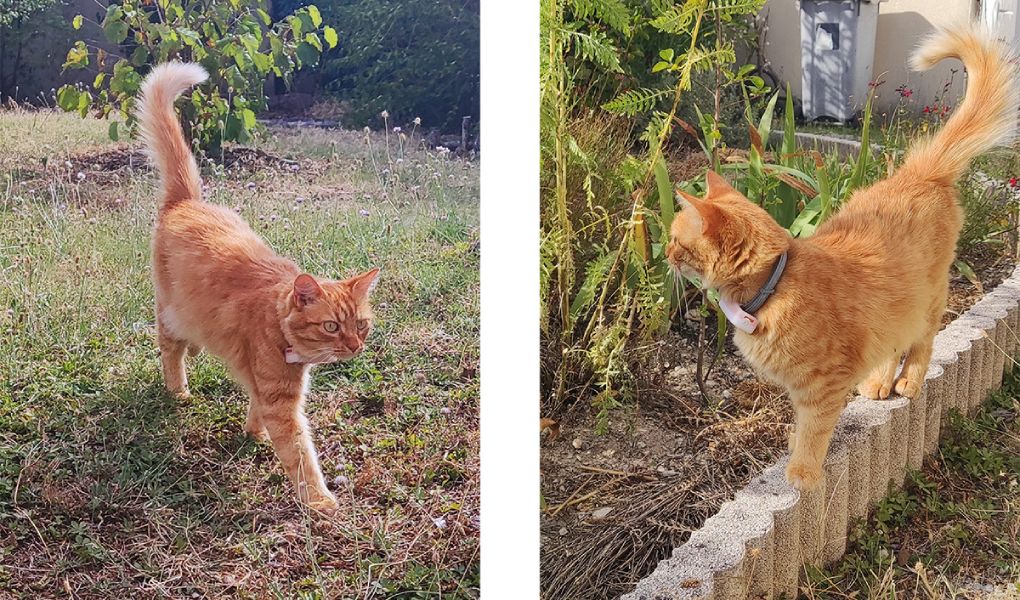
I chose not to use the included collar and instead attached the Weenect XS to the flea collar Plume already wears. As shown in the photos, the device does look a bit bulky for a small cat. This is one of the main drawbacks of GPS cat collars in general: they need to house electronics and a battery, which inevitably adds size. That said, it didn’t seem to bother Plume at all.
A tracker built to handle outdoor adventures
The Weenect XS is IP68 certified, meaning it is fully protected against dust and can withstand submersion in up to 5 feet of water for over an hour. In practical terms, your cat can roll in dirt, roam in the rain, or even jump into a stream without damaging the tracker. The device also operates in temperatures ranging from −4°F to 131°F, making it suitable for most environments. Your cat, however, might be less enthusiastic about extreme weather conditions.
Features and app experience
Thanks to GPS tracking, the Weenect XS lets you locate your cat at any time. Through the iOS and Android app, you can view your cat’s movements using either a standard map or satellite view. If your cat goes missing, you can quickly access the tracker’s address and get turn-by-turn directions with a single tap. A built-in compass points you toward your cat’s location—more practical than a map in unfamiliar terrain. By default, location updates are sent at regular intervals, adjustable from every 30 seconds to every 10 minutes. A “Super Live” mode offers true real-time tracking with updates every second.
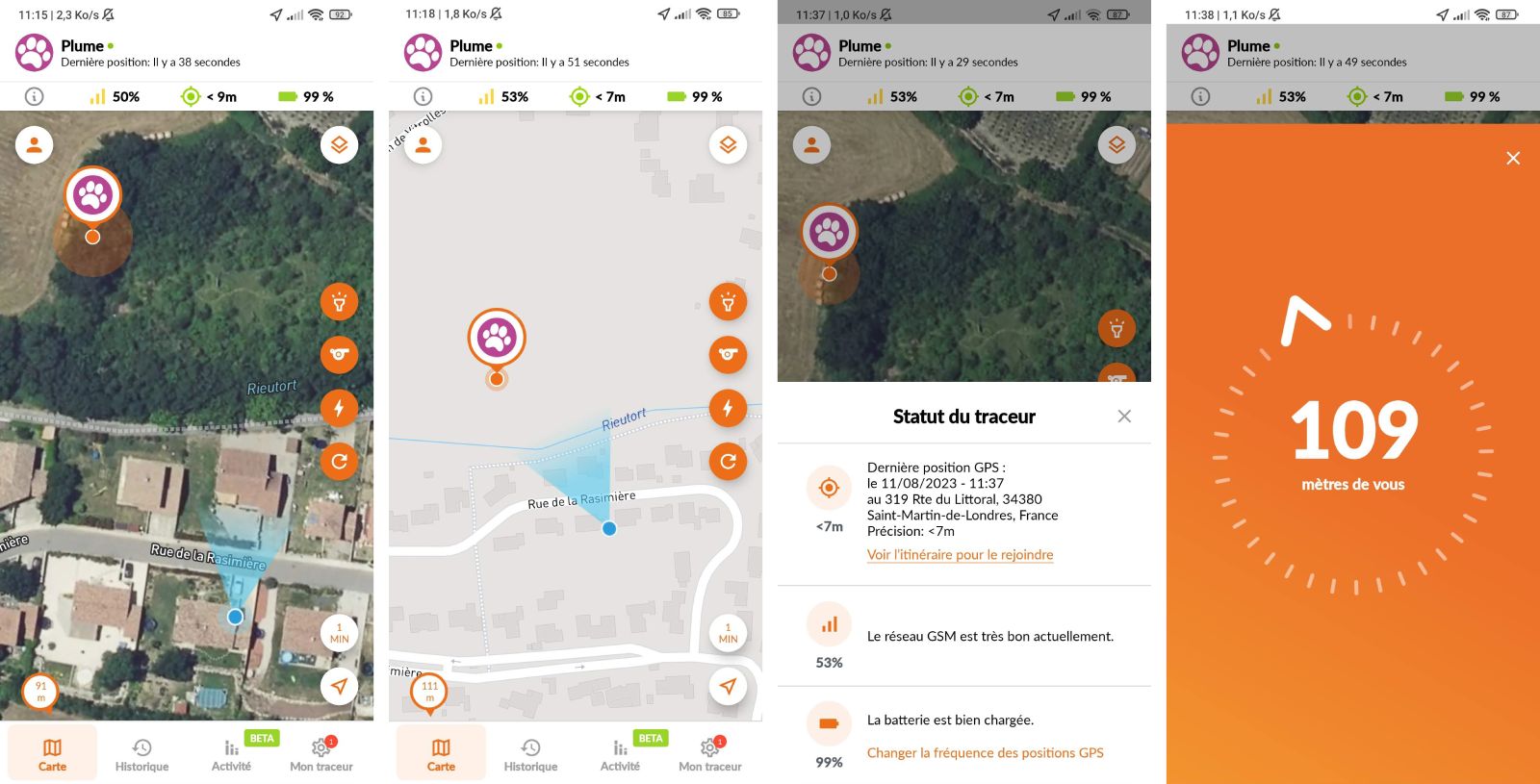
The Weenect XS also features safety zones: virtual boundaries that trigger alerts (via push notification, email, or SMS) when your cat enters or leaves a defined area. These zones are circular, with a radius between about 80 feet and 1.2 miles. This design avoids false alerts caused by the inherent limitations of GPS accuracy.
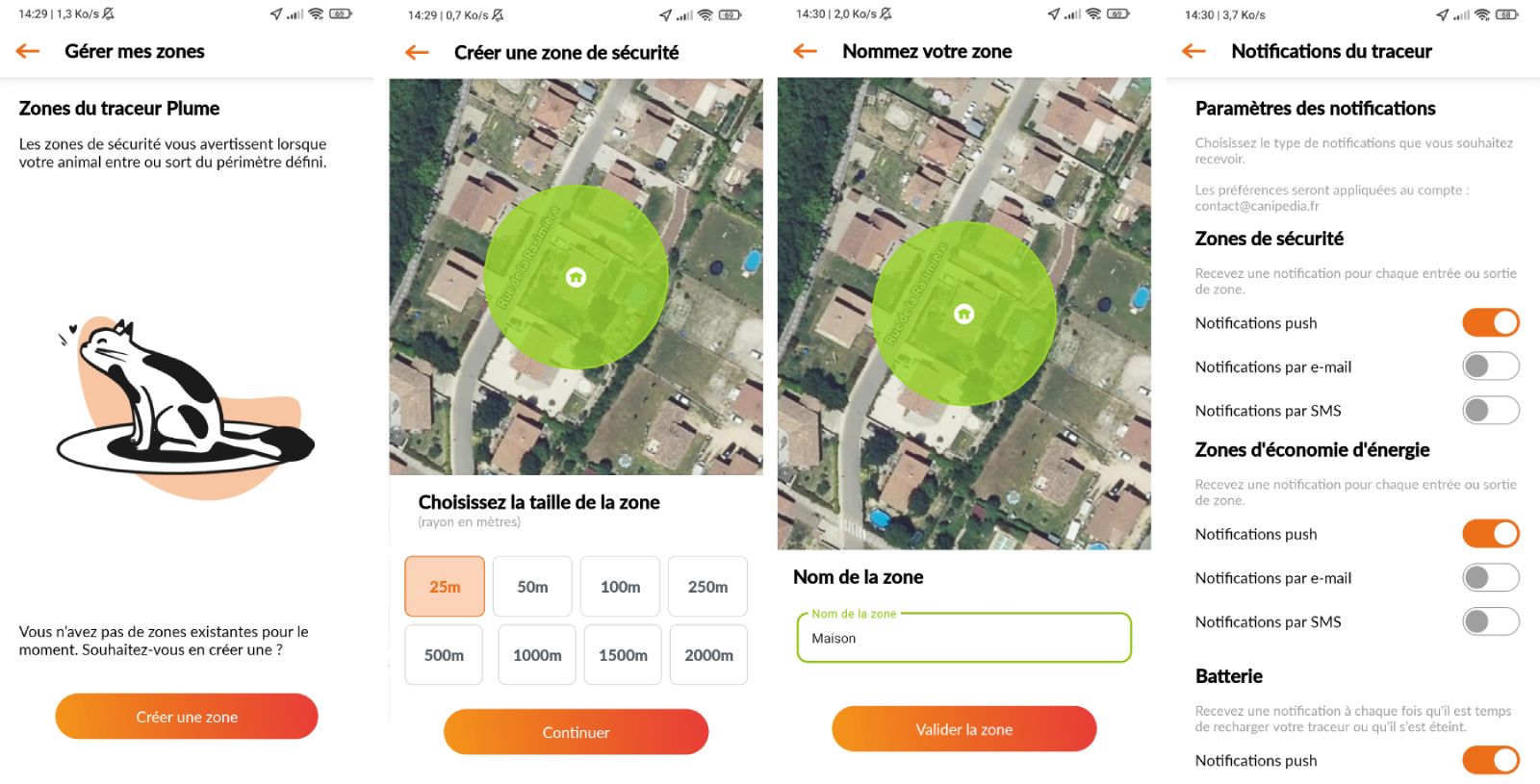
In daily use, the “home zone” notifications proved extremely useful. Since Plume has a large territory and often stays away during the day, it’s reassuring to know exactly when she returns. On several occasions, I received a notification late in the evening, stepped outside to call her, and saw her appear within seconds—something that likely wouldn’t have happened without the alert system.
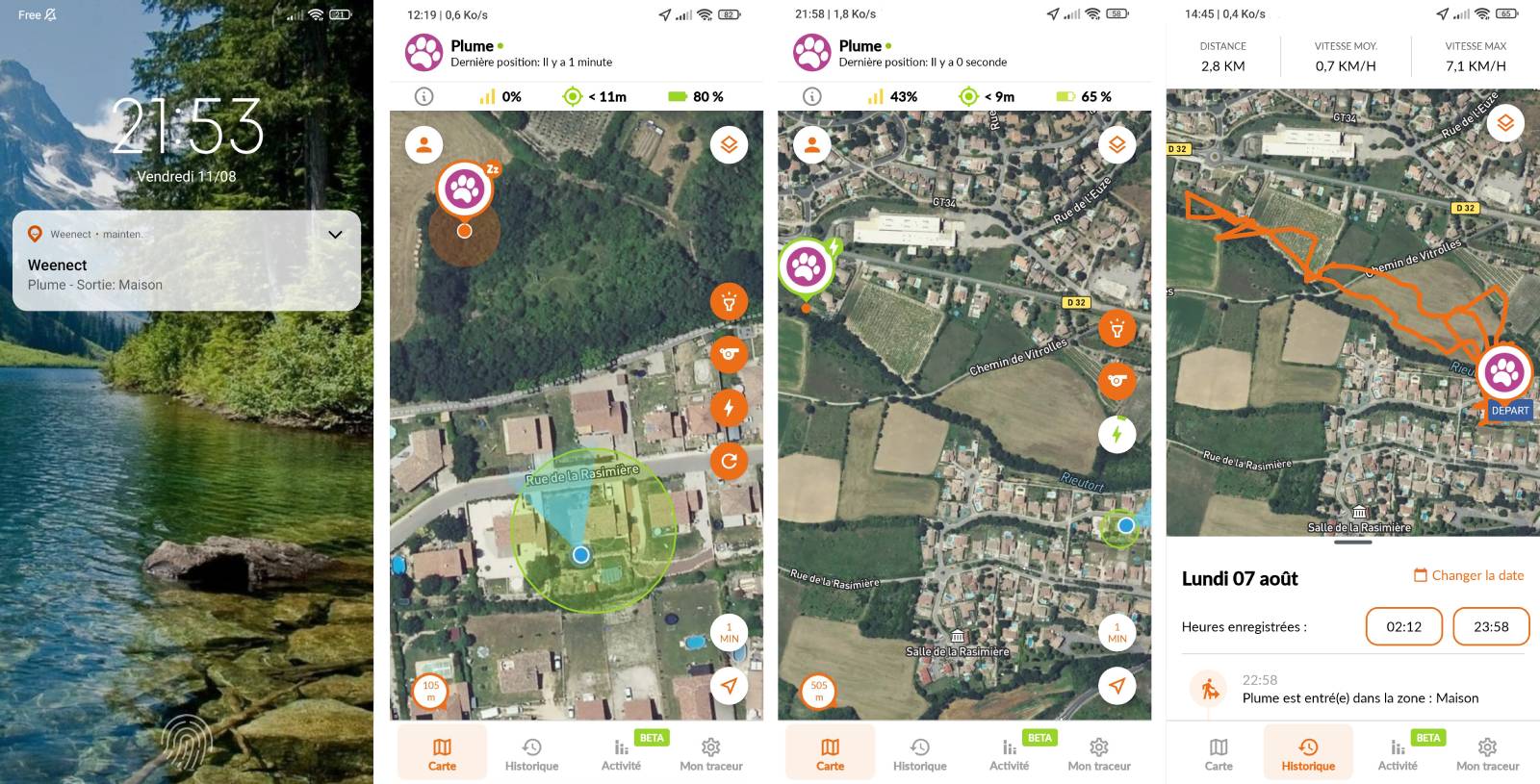
The history mode provides a detailed overview of your cat’s movements over a selected period, including total distance traveled, average speed, and maximum speed. This helped me confirm that Plume wasn’t sleeping at a neighbor’s house, as I had feared, but instead spending most of her time in a small wooded area nearby. I also discovered that her territory extended up to 500 yards from home—far more than I expected. There is also an activity tracking mode that reports steps taken, active time, and rest periods. However, this feature was still in beta at the time of testing and not yet fully reliable.
The tracker alors offers three signaling options: vibration, sound, and flashing light. These can help locate your cat when you’re nearby, but they double as recall training tools. By triggering a signal at feeding time, your cat can gradually associate the alert with food and learn to come home on command—directly from the app.
GPS accuracy in real-world use
Safety zones, activity tracking, and training features are great—but the key question remains: does the device actually help you find your cat? Based on my tests, the answer is yes. While GPS tracking inevitably involves a margin of error of a few yards, the Weenect XS consistently allowed me to locate my cat quickly, without relying on sound or light alerts. The compass feature, however, has its limits. Because it depends on the GPS positions of both the tracker and the smartphone, inaccuracies can compound. It works best when the cat is at a moderate distance; once you’re only a few yards away, the direction indicator becomes unreliable.
All these features consume power, and battery life tops out at a few days. Weenect advertises between 3 and 10 days, depending on usage. In my tests, with frequent use of Super Live mode and a 1-minute update interval, I observed about 2.5 days of battery life.
By enabling power-saving mode—where GPS switches off near a known Wi-Fi network—and increasing the update interval to 3 minutes, I managed to reach around 5 days. Charging from 0 to 100% took approximately 2 hours and 10 minutes using a standard phone charger.
This performance is broadly in line with other GPS cat trackers. The Tractive CAT Mini offers similar battery life, while the Localiz Lookat fares even worse. Trackers with weeks or months of battery life exist, but they rely on radio technology with limited range and far fewer features.
Weenect cat review: final verdict
- Extensive tracking and alert features
- Simple, intuitive mobile app
- Solid build quality with IP68 certification
- Lifetime warranty
- Limited battery life compared to expectations
- Slightly bulky for very small cats
I didn’t expect it, but using this GPS tracker created a stronger connection with my cat. Even when she’s not around, I can see where she is and imagine what she’s doing. It’s reassuring —and for that alone, I’m convinced.
Feature-wise, there's little to criticize. This is probably the best GPS cat tracker currently available. The system is comprehensive and easy to use, with standout features like location history and safety alerts. Activity tracking feels somewhat gimmicky, but given the limited number of GPS updates per minute, precise data would be unrealistic.
Battery life and size remain the main drawbacks—but these are shared by virtually all GPS trackers on the market. At just under 1 oz, the Weenect XS is still among the lightest options available, and its battery life holds its own. For cats sensitive to collars, the tracker can also be attached to a harness.

Even when worn on a collar, my cat tolerated the Weenect XS well. After a short adjustment period, she seemed to forget about it entirely. As for battery life, there’s no escaping regular charging—much like a smartphone—roughly every three to four days.